
Teeth Whitening Before and After: Two Readings
S22 and S12: the typical first reading and latest start-of-session reading at an Ottawa whitening studio, on a 38-step instrument scale. The median client has moved 10 steps so far, measured before any gel.

You have looked at a lot of other people's teeth by now. Two photos and a caption, and still no idea what whitening would do in your own mouth.
Compare teeth whitening before and after using two readings on one instrument. Both readings come before any gel: one at your first session, one at the start of your latest. This page shows those readings across an Ottawa studio's clients.
What a teeth whitening before and after looks like, measured
A measured before and after is two numbers on one scale. At UpWhiten, NanoChroma™ reads your shade on a 38-step scale, from S40, the most yellow, to S2, the whitest. How the scale works is on how the NanoChroma™ shade scale reads.
10 steps At UpWhiten, the median move from a client's first reading to their latest one.
1 in 4 UpWhiten clients who have moved 15 steps or more so far.
99% of UpWhiten clients whose reading has moved now read whiter than at their first.
At UpWhiten, the middle half of clients moved between 6 and 14 steps. And 8% moved 20 steps or more.
These figures cover UpWhiten clients with a first reading and a later session on file, to 11 October 2026. Latest means the start of the most recent session, read on rested teeth before any gel. Many clients are still mid-course.
Most clients start yellow. At UpWhiten, three in four first readings sit at S20 or yellower.
At UpWhiten, clients have gone up to 32.8 shades whiter on the NanoChroma™ scale.
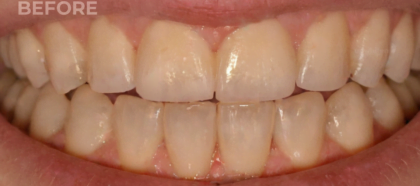
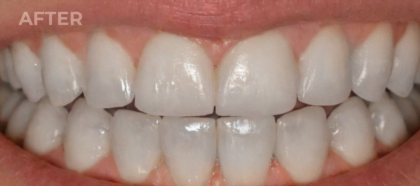
Real client photos, before and after
These clients agreed to share their photos. The readings above put a number on what you see.
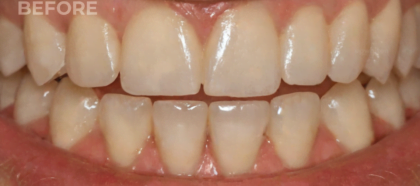
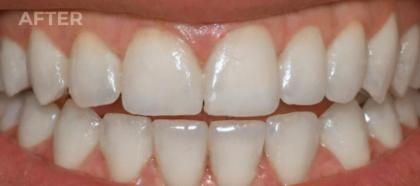
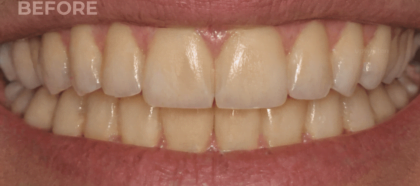
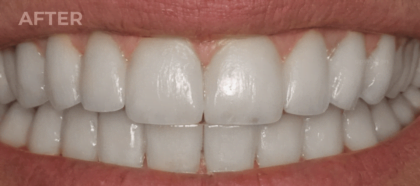
Four more client photos
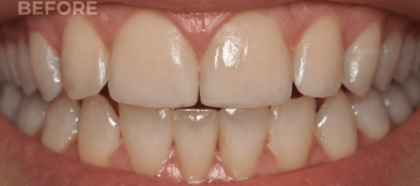
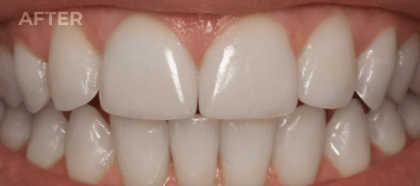
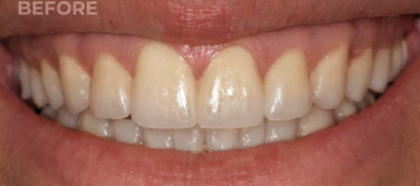
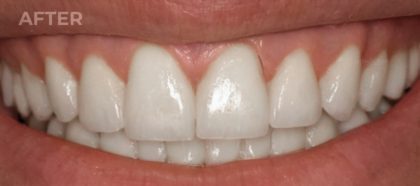
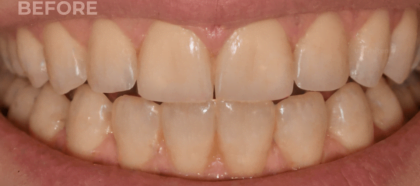
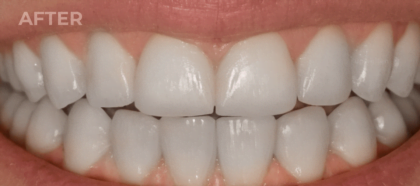
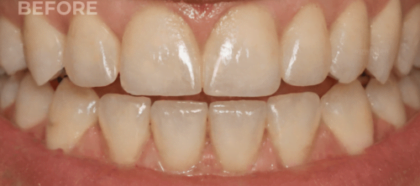
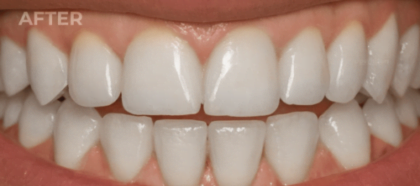
“I'm smiling all the time”
More photos and every published client review sit on UpWhiten's photos and client reviews.
The yellower you start, the further your teeth move
If your teeth are the yellowest, you have the most room to move. At UpWhiten, clients who started at S30 or yellower moved a median of 19 steps.
| Your first reading | Typical latest | Typical move |
|---|---|---|
| Whiter than S18 | S11 | 4 steps |
| S18 to S23 | S12 | 8 steps |
| S24 to S29 | S12 | 13 steps |
| S30 or yellower | S14 | 19 steps |
Find the row that holds your first reading. The last column is how far the typical client in that row has moved so far.
Published research found the same pattern. Across 11 pooled trials, each shade-guide step yellower at the start added about two-thirds of a shade-guide step of whitening. [2] In a trial of 92 people, the darker teeth changed colour more than the light teeth. [3]
Why yellow teeth hold you back before the after
You know the moment. Someone lifts a phone for a group photo, and you smile with your lips closed.
You want to laugh in that photo and never think about your teeth. What stands in the way is how other people read a smile.
Shown the same applicants with and without dental flaws, hiring managers judged the ones with flaws 52% less employable. [4] That study changed the whole smile, not just its colour.
Colour alone moves the verdict too. When researchers changed only tooth colour on the same faces, darkened teeth got poorer ratings for traits such as success and intelligence. Whitened teeth got the best ratings. [5]
In a test that changed both tooth colour and spacing, yellowed teeth cut attractiveness ratings, with a markedly bigger hit for women's faces. [6]
So people hide. Of adults surveyed, 39% always or sometimes avoid smiling in photos. [7] Yellow or stained teeth were the second most common reason they gave. [7]
The hiring and photo-avoidance numbers cover the whole smile. The trait ratings cover tooth colour only. The attractiveness test changed colour and spacing together.
In a trial of 92 people, fewer felt embarrassed smiling and showing their teeth after whitening. [8] Across nine trials and 489 people, self-confidence rose as more shades were gained. [9]
Why a before-and-after photo flatters
A photo flatters because dry teeth and kind light read whiter than the teeth you live with.
Thirty people sat with their teeth drying for half an hour. By then, 85% of the teeth had shifted past the point where a colour change counts as unacceptable. [1] A day later, 90% of readings were back under the point where a change shows at all. [1]
That is why the latest figure at the top of this page is read at the start of a session, on rested teeth. Teeth just out of a session are dry, and their colour settles over the next day. [1]
The eye is the weak link. Across six pooled studies, an instrument matched tooth shade more accurately than a shade guide held up by eye. [10]
UpWhiten's own records show why. The middle half of clients matched to one common dentist tab, 3M1, read anywhere from S19 to S25 on NanoChroma™.
One tab holds a range of real shades, and a photo or a look cannot split them. That is the old way of judging a result. Two readings on the same instrument, both on rested teeth, put a number on it.
See your own before and after before you pay
Photos flatter, tabs group shades together, and a box of strips reads nothing.
That is the old way, and nobody predicts your result before you pay. Only half the people treated on dentist trays still held their whitening at 6 months. [11] In the chair, the typical shade-guide result levelled off by the second or third session. [12]
Predictive Whitening™ starts from the other end. NanoChroma™ reads your shade before any gel and predicts where your teeth will land. You set your target.
At UpWhiten, NanoChroma™ predicts your result before your first session, with 99.98% prediction accuracy.
UpWhiten is the only NanoChroma™ provider in Ottawa. At UpWhiten, every session is read at its start and its end.
The gel is a special professional formula with nano-hydroxyapatite, the same mineral your enamel is made of.
Our record is under 6% temporary sensitivity.
At UpWhiten, we serve 1,000+ clients.
| Route | Your before and after | Known before you pay? |
|---|---|---|
| Predictive Whitening™ at UpWhiten | A NanoChroma™ reading before any gel, then one every session | Yes, predicted by NanoChroma™ |
| Dentist chair, the old way | A shade tab held up by eye, then the same tab on the day | No |
| Dentist trays, the old way | A tab at the fitting, then your mirror weeks later | No |
| Whitening strips | Two phone photos in different light | No, nothing is read |
The studio works in one order, with your reading first, your prediction second and your price third. The Ideal Shade Package then covers as many sessions as your teeth need, until your ideal shade or your genetic limit. Each session is read at both ends, so your own before and after builds up as numbers.
At UpWhiten, most clients set their target between S6 and S8 on the NanoChroma™ scale.
Asked what colour they want, about half the people taking UpWhiten's Smile Assessment chose super white teeth.
- Take a one-minute Smile Assessment of your teeth.
- Come in for the free shade scan: NanoChroma™ takes your first reading and predicts your result.
- See your exact price for the Ideal Shade Package, then decide.
You see your exact price at the free scan. What the package covers is on what the Ideal Shade Package includes.
How we made this page
Built from the studio's own NanoChroma™ records to 11 October 2026, seven consented client photo pairs and 15 published studies, each re-read on 28 October 2026.
Method and data
- Studio readings: the first NanoChroma™ reading and the start reading of the latest session, taken before any gel, for every client with both. Readings outside S4 to S38 were left out as probable entry errors.
- Clients whose two readings match were left out, because the records cannot tell a client still on the first session from no change.
- Figures are medians and shares computed inside the studio's records. Client counts are not printed.
- Latest is not final: many clients were still mid-course on 11 October 2026.
- Tab comparison: clients whose first dentist-tab match and first NanoChroma™ reading are both on file, for tabs with enough clients to read a middle half.
- Targets: every ideal shade set at a consultation.
- Photos: the studio's consented set only. No reading is printed under a photo, because none is attached to these pairs.
- Studies: every number re-read in its PubMed abstract. Labels say whether a study changed the whole smile or tooth colour only.
- Download every studio figure on this page: the shade readings CSV.
Questions people ask us
How long until I see a difference?
On day 1. At UpWhiten, a second NanoChroma™ reading is taken at the end of your first session. Your next session starts with a fresh reading, taken on rested teeth before any gel.
Does the colour fade back after whitening?
Colour reloads with what you eat and drink, on every route. Four and a half years after in-office whitening, results were still clinically acceptable.[13] Another trial found no significant colour regression 12 months on.[14] Over-the-counter kits relapsed within six months.[15] At UpWhiten, ForeverGlow membership keeps your shade on a schedule.
Will my crowns or veneers change colour?
No. A crown, a veneer or a bonded front surface keeps the colour it was made in, on every whitening route. Your first NanoChroma™ reading shows where they sit before you spend anything, so your target can match them.
Which shade do people pick as their target?
At UpWhiten, the most common target is S8 on the NanoChroma™ scale. Of all the targets clients have set, 68% sit between S6 and S8. Almost nine in ten sit at S10 or whiter.
Next step
The one-minute Smile Assessment, then your own first reading
The package itself: The Ideal Shade Package
Sources
- Clinical effects of dehydration on tooth color: How much and how long?
- Predictive factors on the efficacy and risk/intensity of tooth sensitivity of dental bleaching: A multi regression and logistic analysis.
- Evaluation of the Efficacy and Color Stability of Two Different At-Home Bleaching Systems on Teeth of Different Shades: A Randomized Controlled Clinical Trial.
- Dental esthetic and the likelihood of finding a job in Saudi Arabia. A cross-sectional study.
- The impact of tooth colour on the perceptions of age and social judgements.
- Evidence to suggest that teeth act as human ornament displays signalling mate quality.
- Dental aesthetic self-perception, smile satisfaction and associated factors among adults: A cross-sectional study.
- Changes in oral health related quality of life after dental bleaching in a double-blind randomized clinical trial.
- The influence of dental bleaching on patient's quality of life: A multistudy analysis of aesthetic and psychosocial outcomes.
- Color difference for shade determination with visual and instrumental methods: a systematic review and meta-analysis.
- Effectiveness of dentist-prescribed, home-applied tooth whitening. A meta analysis.
- Time to color stabilization during in-office bleaching with 35% hydrogen peroxide: A prospective clinical study.
- In-office Bleaching After a Desensitizing Protocol: a 4.5-Year Follow-up of a Randomized Controlled Trial.
- One-year bleaching efficacy using two HP products with different pH: A double-blind randomized clinical trial.
- Evaluating the efficiency of two different over-the-counter tooth whitening systems: a randomised controlled clinical trial.
We are not a dental clinic and do not provide dental diagnosis or treatment.

Wahid Baitul · Co-owner, UpWhiten
Wahid Baitul is a co-owner of UpWhiten, the Ottawa teeth-whitening studio. He joined early, has run its in-studio Predictive Whitening™ sessions since 2024, and writes the pages about how the studio works and what its own records show.
Clinical review: Dr. Hafsa Cherid, DMD, is a dentist who reviews the clinical statements on UpWhiten pages for accuracy against the studies they cite; UpWhiten is a studio, not a dental clinic, and her review does not make it one. Her record on the RCDSO public register.